A defined neuron, exposure, and endpoint 7 October 2026
A reference neuron over time
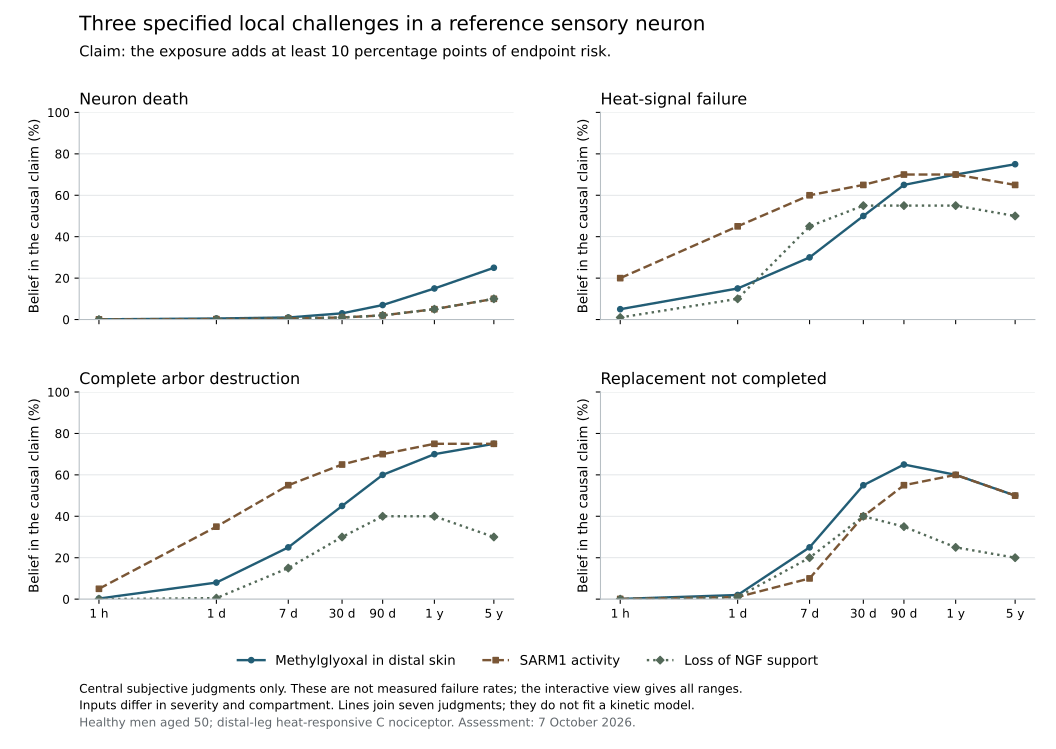
What might one specified perturbation do to a healthy sensory neuron? Compare three mechanisms, from one hour to five years, while keeping death, loss of function, destruction, and repair distinct.
The reference: a mature, heat-responsive cutaneous C nociceptor in the distal leg of a healthy 50-year-old man. Full definition
Compare endpoints over time
Complete physical destruction of the original arbor, with no viable remnant. Regrowth does not erase the event.
Chance the specified exposure adds ≥10 percentage points of endpoint risk
q = P(true risk difference ≥ 0.10 | evidence). These are subjective judgments about a causal claim, not the neuron’s failure risk.
Loading the assessments…
Arbor destruction
Healthy reference → reference + exposureSelect a mechanism for detail
Exposure severity and compartment differ. These curves compare the specified challenges, not intrinsic mechanism potency.
The specified exposure
Does diabetes produce this exposure?
All seven judgments
Scroll sideways for reasons and sources.
| Time | Low | Central | High | Reason and sources |
|---|
Evidence behind this mechanism
Numerical checks
Primary sources and their limits
The reference and the comparison
Healthy reference (H) versus the same reference plus one specified perturbation (H+M). Other initiating inputs are matched; downstream chemistry, physiology, compensation, and tissue responses can change. Inputs persist to each horizon unless the mechanism assessment specifies otherwise. Both arms age equally.
This is a person-weighted, then neuron-weighted, then arbor-weighted population of healthy 50-year-old men without neuropathy. The reference is a mature peptide-producing, heat-responsive C nociceptor in lateral distal-leg skin, 10 cm above the lateral malleolus. Its soma, peripheral and central axons, skin, glia, vessels, and immune environment remain connected. Identity is established at baseline and retained if marker expression changes. This scope is not a claim that it is the median human neuron.
The baseline arbor and heat assay
Choose one arbor at baseline by its basement-membrane entry and epidermal descendants. Fix its skin territory and original viable connected length, L₀. The neuron must generate at least five expected excess action potentials at the central axon near dorsal-root entry during the baseline assay.
The assay starts at 32 °C, rises at 2 °C/s to 47 °C, holds for 5 seconds, then returns to 32 °C at 2 °C/s. Count excess spikes over a matched 32 °C sham within 30 seconds. Use the same territory and input at later times. The expected response avoids single-trial noise. Readouts refer to matched counterfactual systems at each time, avoiding repeated test-induced injury.
The four endpoint definitions
- Neuron death
- Completed irreversible loss of the viable identified DRG soma by T, from any cause. Marker loss, axon disconnection, or a dying fragment is insufficient. This is a cumulative event.
- Heat-signal failure
- The expected excess spike count in the specified assay at T is at most 10% of its baseline value. This includes failed transduction or propagation; soma death counts as failure. This is a current state that can recover, not a measure of conscious pain or a claim of permanent failure.
- Arbor destruction
- The baseline arbor has physically degenerated or been dismantled by T, with no viable remnant. Retraction of a living branch alone is not destruction; a disconnected viable fragment has not yet completed destruction. Regrowth does not erase the event. Substantial partial damage may occur without complete destruction.
- Replacement not completed
- In a separate matched challenge, remove the selected epidermal arbor at time zero while preserving the parent neuron and proximal axon. By T, that neuron has not yet made a connected arbor in the original territory reaching both 50% of L₀ and 50% of its baseline heat response. The first time both are reached is completion; later loss belongs to the other endpoints. Death before completion counts as non-completion. This concerns repair after a defined lesion, not spontaneous injury incidence.
How to read the probability and the sensitivity range
Let pH and pM be the true person-weighted endpoint probabilities in the two specified reference populations. The risk difference is δ = pM − pH. The chart shows q = P(δ ≥ 0.10 | available evidence): our belief that the exposure adds at least ten percentage points of endpoint risk. For replacement, the endpoint is non-completion.
The ten-point threshold, response cutoff, and repair cutoffs are chosen conventions. Low, central, and high are subjective judgments under stated evidence-transfer assumptions, not empirical confidence limits or a fitted Bayesian posterior. q is neither pM nor the fraction of parameter samples above a cutoff.
Newly completed death and destruction are absent at time zero. In the lesion challenge, neither arm has yet repaired, so the difference is zero. Cumulative death and destruction cannot decrease; functional failure can recover; first-repair non-completion cannot increase. The risk difference and q can still rise or fall as the control arm catches up.
How this differs from prevention in diabetes
Diabetes (D) versus diabetes with the mechanism corrected asks how much injury correction could prevent. It is a different contrast from H versus H+M, not diabetes plus an additional dose. Interactions and redundant routes can make the answers differ. That contrast is not estimated in this view.
Whether diabetes creates the specified exposure is assessed separately for each mechanism. Evidence from established disease does not by itself establish prevention of incident DPN. The earlier 45 assessments ask different population questions and retain their original probabilities.
Full specification & common sourcesDownload all judgments (JSON)All four endpoints (SVG)